Pragmatic Eco-Optimism
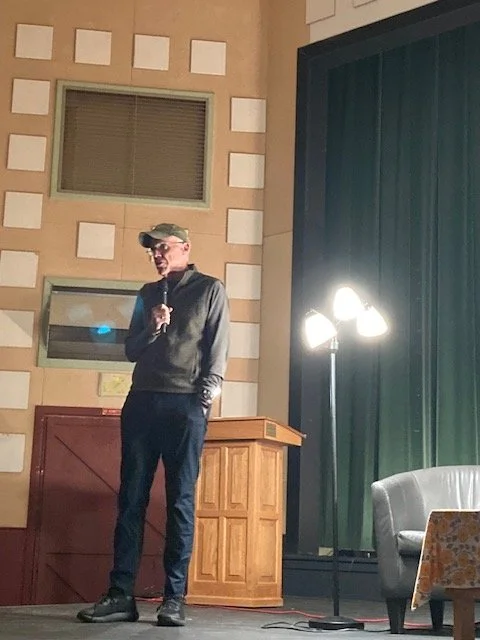
Bill McKibben walked on to the Choteau stage wearing jeans, a long-sleeved t-shirt and a baseball cap.
Somewhere in his remarks, he mentioned visiting with the Pope about using solar energy to create the first energy-independent nation in the world, the Vatican.
Like many small Montana towns, Choteau embraces people from many backgrounds.
Still, this was a rare opportunity to discuss how we use our land, air and water to create the energy to power our economy with someone listed as one of the 100 most influential thinkers on our planet.
Bill has spent the last 35 years encouraging people to act regarding climate and justice by founding The Third Act and 350.org.
He has written 21 books and untold articles for periodicals ranging from the New York Times to Rolling Stone.
When I volunteered to speak on the same stage, I had no idea who Bill is, but I soon learned.
Bill said ranchers are rarely included in his discussions or even join his audience.
This comment surprised me.
Ranchers are on the forefront of practical environmental solutions.
We pragmatically manage the marriage of long-term environmental viability and economic reality.
We understand how all the cogs – land, water, sun, air, markets, financing, family dynamics and communities – work together.
When something impacts one, usually it impacts the others.
In his latest book, Here Comes the Sun, Bill calls for us to harness solar energy to power global economies and reduce our dependence on oil -- and the Strait of Hormuz.
He said Belgium allows citizens to hang solar panels and plug them in to living room outlets.
Those panels generate about 20 percent of a household’s energy needs.
In Pakistan, solar generates about a third of the electrical grid.
Of course, the sun doesn’t always shine so energy needs to be stored.
Lithium batteries are expensive, but sodium batteries are on the horizon.
A question from the audience prompted Bill to note that the U.S grows 60 million acres of corn and 30 million acres of that production goes to ethanol.
He wondered aloud at the income farmers could make without investing in expensive annual inputs if those 30 million acres were covered with solar panels.
One rancher in the audience suggested we start with covering rooftops, parking lots and canals instead.
In fact, Germany encourages poor farmers to lease land to solar companies, removing it from food production and creating an adverse secondary consequence.
Under those solar panels, soil microbes aren’t as active. The soil is slowly dying.
I was honored to talk about another secondary consequence of renewable energy production.
Our coalition is fighting back against Montana Renewables’ plan to inject biofuel wastewater sludge into old oil wells near my ranch.
Clearly, dumping nasty waste down a hole in the name of environmental progress is hypocritical.
Montana Renewables is one of five major producers of biofuels in North America.
Four of those major producers treat their wastewater onsite.
Yet, the Environmental Protection Agency recently granted a permit that allows Montana Renewables to inject gunk into the Madison Aquifer.
Our coalition sued the EPA, asking the Ninth Circuit Court of Appeals to reverse the decision to exempt a portion of the Madison Aquifer from current protections.
Instead, we encourage Montana Renewables to make their biofuels truly environmentally sustainable by implementing a simple solution: deliver on their promise to build an onsite wastewater treatment plant.
As Bill emphasized, we generate power when we use our collective perspectives, experiences and ideas to use our natural resources deliberately and carefully, to grow our economy and to make life easier.
Bill’s message is worth remembering.