First Day of Food Production
On Tuesday, I opened the email that I had been waiting months to receive.
The USDA approved my food manufacturing facility so I could finally make my ready-to-eat meals, using Montana beef and lamb.
It has been a long slog.
I submitted my first plan back in March.
Revisions came in June, August and September.
By Tuesday night, I was exhausted.
I hadn’t realized how much energy I was expending on worry.
By Wednesday, I had ordered the perishable ingredients – carrots, celery, potatoes and onions – that go into the beef and lamb stews, along with lamb curry.
They would arrive on Monday afternoon.
My permit allowed me to start producing meals on Monday morning, so I started with marinara sauce.
Marinara sauce doesn’t need the ingredients that would arrive on Monday afternoon.
Halfway through marinara sauce preparation, we realized we didn’t have enough fennel and tarragon.
I raced to the store.
And it was a true race. I paused to talk to only two neighbors.
Basic food safety allows a 2-hour window between the time the sauce is ready to go into the pouches, and the pouches go into the retort pressure cooker.
This time limit is based on food-borne bacteria biology -- bacteria won’t reach high populations within two hours – even better, it will be killed by the 250-degree heat in the pressure cooker.
The clock ticked relentlessly.
The boiler took a long time to start.
Fortunately, the crew worked efficiently.
Our practice runs during the summer paid off.
They consistently filled and weighed every pouch to 16 ounces.
We needed to test a few random representative pouches for critical factors.
The supportive USDA inspectors watched and learned along with the rest of us.
First, I cut open three pouches while they were under water and captured the air in each pouch.
Turns out, air transfers heat slowly so if the pouches have too much air, they won’t heat as quickly as they need to.
Catching air bubbles is actually fun and the pouches passed the residual air test with flying colors.
Yet tick tock went the clock.
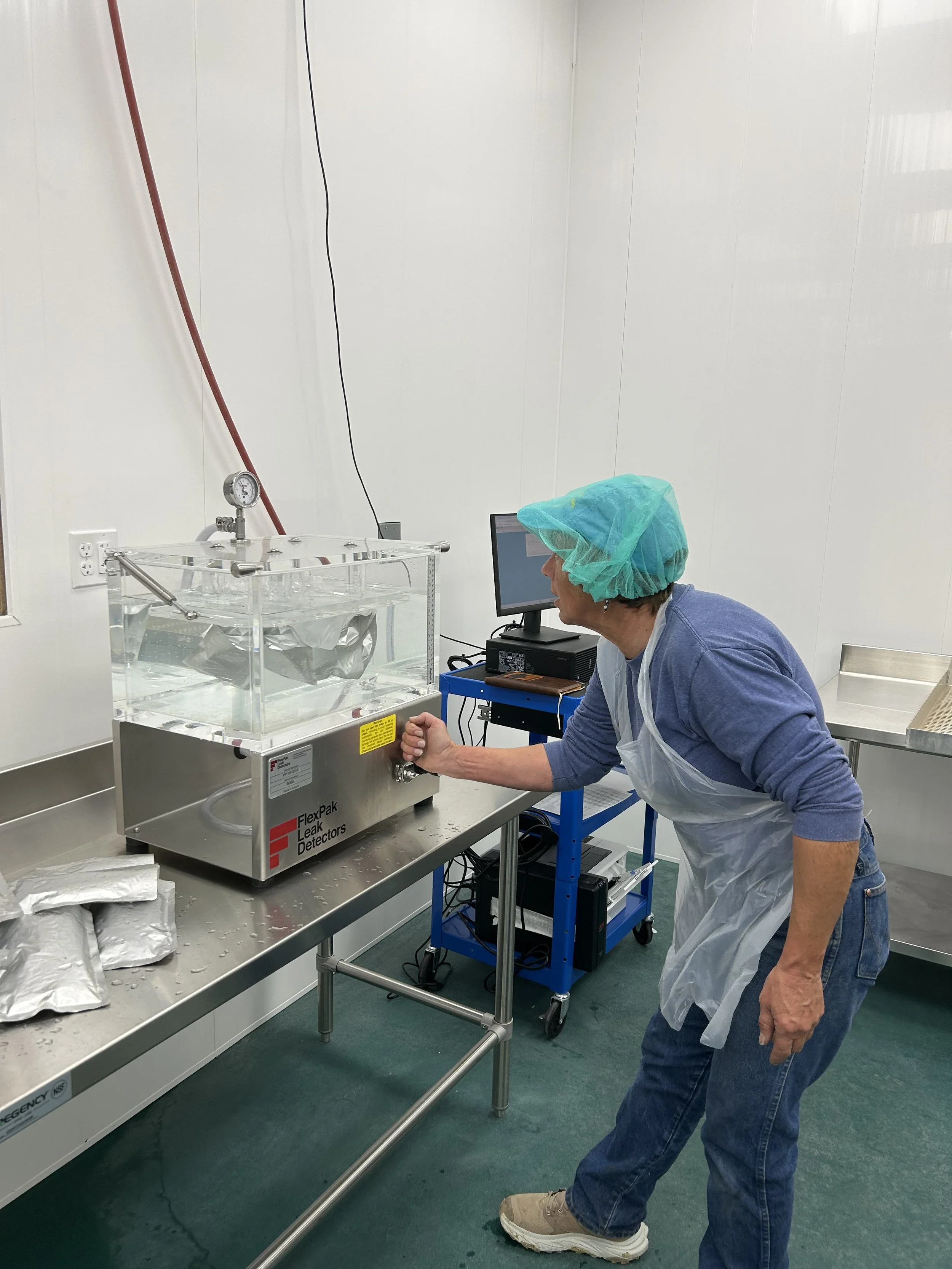
Next, I needed to check for leaky seals.
This is fun, too.
I stuck five pouches into a modified fish tank and sucked the air out of it, watching for bubbles floating up from the pouches for 30 seconds.
No bubbles. Another win.
Tick tock went the clock.
We raced to load the pouches into the retort.
The retort would not accept my password.
My new life goal is to be allowed to operate my own machine under my own name.
Maybe someday that dream will come true.
Meanwhile, I hacked the (insert your favorite derogatory descriptor) machine.
Tick tock.
By the time the retort started, we had missed the deadline by 11 minutes.
I processed the marinara sauce in the retort, but I put the pouches in my Hold storage until my food safety expert consultant tells me how to handle them.
He is on vacation and without internet service this week.
By Monday afternoon, I was frustrated at my learning curve and equipment blips.
But Tuesday dawned with a plan to make Beef Creole.
The crew worked efficiently again.
The critical factor tests went faster.
The retort still would not accept my password, but I hacked the system faster.
We beat our 2-hour time limit by 45 minutes.
I have USDA-approved, ready-to-eat, shelf-stable Montana-raised beef and lamb meals for sale.
It only took me 15 years, 9 months and 29 days to get this far.