Gusty Grain Bins
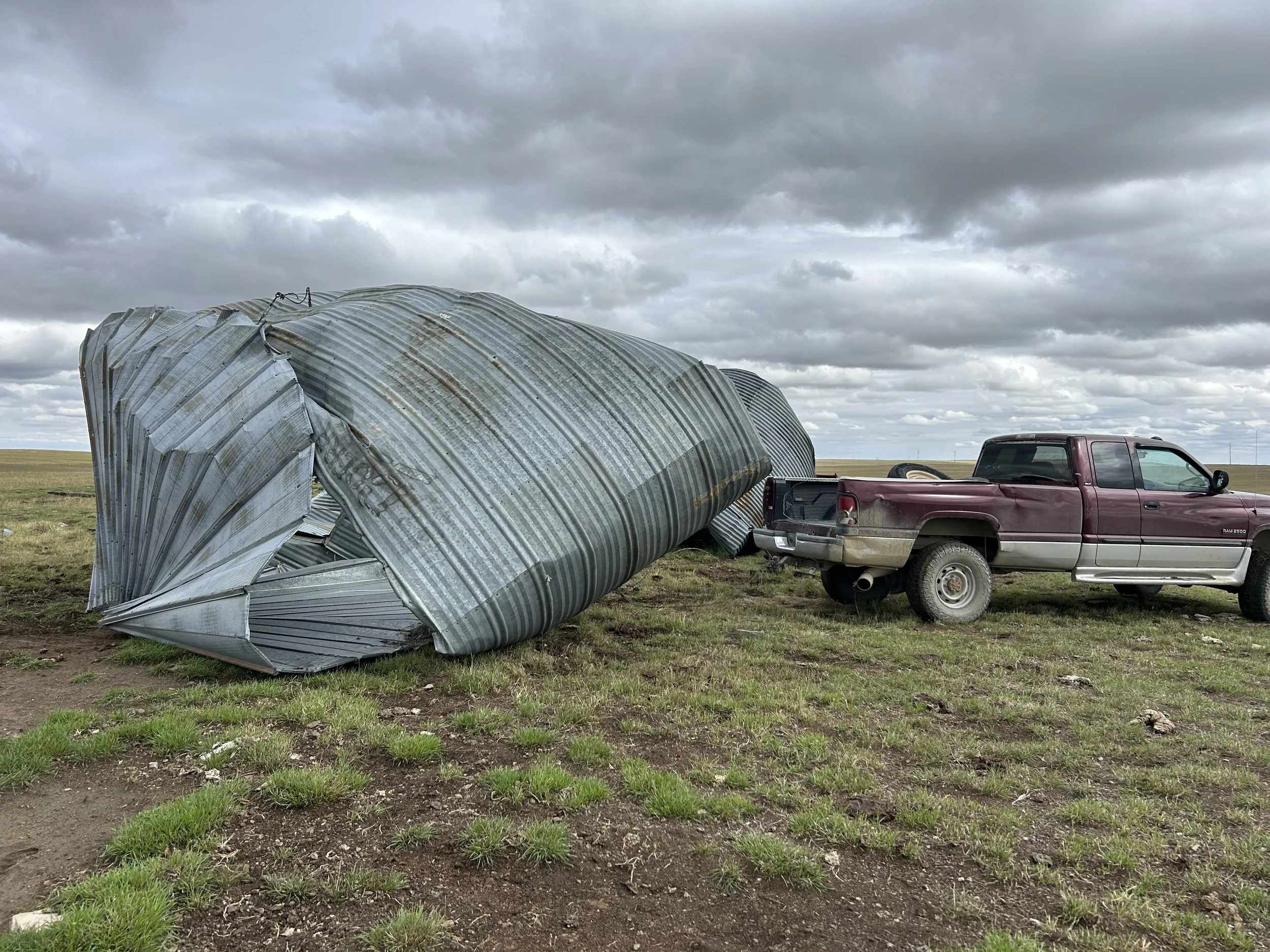
My yearlings have been grazing all summer at an old farm I call the Hicks Place.
Every time I check on these teenagers, I think about the people who lived on this hill and did their best to farm this sandy ground.
They left clues to their lives, remnants of function, not decadence.
The rusty clothesline poles must have dried handwashed jeans and shirts.
Some days, my jeans are coated with grease and my shirts are soaked in sweat. No doubt, the clothes that hung on that line had been scrubbed clean from grime even harder to remove.
Shallow holes are filled with various worn-out dreams – an electric range that must have brought the expectation of easier chores, rotting narrow tires and wheels from a truck that promised to carry heavy loads faster, and long sticks of galvanized pipe that fed water to indoor plumbing.
A couple of buildings wobble on dehydrated walls, breezes blowing through their graying pride.
A pump house shelters a well that provides the nucleus of life at this place.
The well determined where the house would be built, how the pipes would run and where the clothes would be washed and hung to dry.
The house, like the family, is gone now.
A row of four metal grain bins shelters the empty space where a home once stood.
Farther away, another grain bin waits for seeding-time action near a hole full of old shop detritus.
This little spot carved from the prairie must have yielded a lot of wheat to fill those grain bins.
What once was the yard of the homesite rises above the cropland, clearly delineated by a 2-foot drop to formerly seeded rows.
Two feet of fertile soil blew away with the gusty hilltop winds before the federal government paid someone to plant perennial forage and anchor the soil to this place.
That drop, that two feet of emptiness, makes my heart ache.
As I stand in that yard looking at the forage growing where someone once plowed the land and planted the wheat, I wonder if that person felt her dreams blow away with the clouds of dust that were supposed to feed her crops.
She depended on the soil at this place she loved. Yet every time she plowed and planted and harvested her crops exactly the way she had been taught – and she had learned from the best – she laid naked that soil, exposing it to robber winds.
So I’m sure she snatched the first chance to blanket her land, taking the federal program money so she could still hang her clothes from the familiar line.
I can tell she was one of the first because forage experts have learned a lot since they recommended the species that now grow on this land.
Everything evolves, especially knowledge.
Those experts now recommend a much more diverse mix of palatable grasses and flowering plants than they suggested when the federal program began.
Yet some things never change.
The wind still blows on that hillside.
This summer, it blew from a slightly different direction.
The empty grain bins staggered. Their moorings stretched.
When one wire snapped, a bin lifted and then rolled across the pasture.
My yearlings dashed away to safety.
When the wind died down, those curious teenagers circled the mangled metal, sniffing, tasting, then laying in its shade.
I ruined their fun when I towed the mangled mess back to the homesite where it is less likely to blow through a fence.
I realized the wind and the land had colluded to clean up well-intentioned yet misguided management of this place.
I reminded myself to learn from them more often.