
Abandoning Internet Homesteading
Last week, a group of students wanted to interview me for background on a project they were working on over Zoom.
Ugh.
I suggested a phone call instead.
My internet is so slow that video meetings are delayed and full of static.
Typically, I turn the video portion off during a meeting and that seems to speed the connectivity, but we still end up waiting and then speaking over the top of one another.
My slow internet connection is not conducive to effective communication.
Of course, the simple solution would be to pay for faster internet service.
But my ranch sits in a No Man’s Land of fiber optic cable communication.
My best internet service is via satellite.
About nine years ago, I upgraded to Hughesnet. The kids were so excited that we could finally stream Netflix movies.
For $100 a month, the movies still buffered.
After three tries, we went back to DVDs.
At least it was better than dial-up.
Lately, enough of my friends switched to Elon’s satellites so that I began to consider it.
The monthly subscription costs about the same and they promise fast internet.
I watch the satellites whisk over the sky at night and wonder how the whole system works.
But the Ukrainians seem to be happy.
They can’t afford buffering as they fire anti-missile rockets so the service must live up to its promise.
I added Elon’s satellites to my to-do list, but toward the bottom.
I was in no hurry, except when conference calls appeared on my calendar.
Then I read an article that said Hughesnet is about to go bankrupt.
Maybe it’s true, maybe it isn’t, but I suspect more than just my friends are switching satellites.
The Starlink box arrived within two days.
The directions said to point the receiver to the north, where most satellites orbit.
Oh dear.
The Graham Ranch National Forest, all 11 trees, are on the north and west sides of the house, blocking the wind and line of sight to the sky.
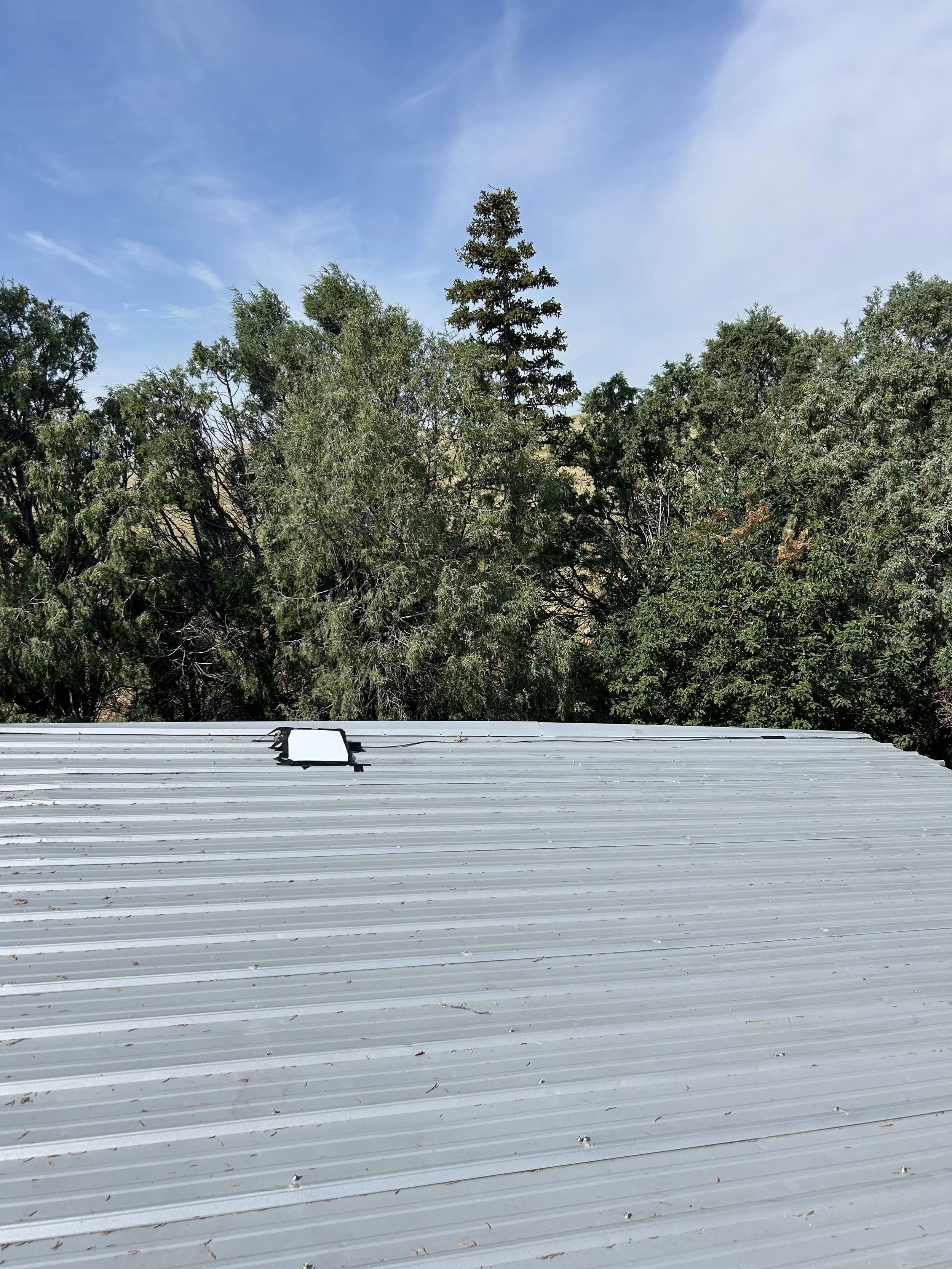
I climbed up on the roof, where the cows and cats were less likely to knock the receiver out of whack.
Somehow, my phone found an opening through the trees for the receiver and, as a bonus, I had plenty of CAT-5 cable to reach the corner of the house where the old Hughesnet cable entered my basement.
But the old hole was too small.
Cedar siding smokes when a dull drill bit bores through.
When the smoke thickened enough to make me cough, I used a syringe to squirt water into the hole where the smoke came out.
Drilling this hole took two days of intermittent drilling.
After all, decent internet wouldn’t really matter if my house burned down.
Then the stars aligned.
I did a little dance when I spotted daylight from the basement.
No doubt, several mice in my backyard danced, too, but I could deal with them later.
I climbed back up on the roof to permanently secure Elon’s receiver.
A lot of Gorilla duct tape and a couple of 2 x 4 blocks of wood held the satellite receiver in place.
If I lose internet service the next time the wind blows, I’ll know I need to use more duct tape.
While I was up there, I added some silicone to the vent holes and chimney – one less maintenance job to worry about in January when silicone won’t stick to the icy metal roof and neither will my shoes.
I haven’t tried to stream a movie yet – I’m not sure I’m quite ready to leave my internet homesteading era.
But when I’m ready, I’ll have what I need, thanks to dull drill bits, Gorilla tape, and Elon.